Ashwagandha Benefits for Men: Cortisol, Stress & Testosterone
| What it is | Ashwagandha (Withania somnifera) is an Ayurvedic adaptogen — a herb used to support the body’s response to stress. |
| How it works | It acts on the HPA axis (the stress-response system), helping the body manage cortisol and stay calmer under pressure. |
| Testosterone link | Indirect: chronic stress and high cortisol work against healthy testosterone, so a calmer stress response helps the body maintain its own normal levels. |
| On a label | Look for a root extract standardised to a withanolide percentage (named extracts like KSM-66 or Sensoril are well-characterised examples). |
Ask which supplement has quietly become a staple for busy, stressed men and the answer is almost always the same: ashwagandha. But most articles either oversell it as a testosterone booster or reduce it to a vague “calm” herb. The real story — and the genuinely useful ashwagandha benefits for men — runs through one central system: your stress response. This guide explains how ashwagandha and cortisol are connected, why the ashwagandha and testosterone link is indirect but real, what withanolide standardisation means, the dosing context, and how to read a label.
As always, this is general wellness information, not medical advice. Ashwagandha is a traditional adaptogenic herb used to support the body’s stress response — it is not a treatment for any medical condition.
What is ashwagandha (Withania somnifera)?
Ashwagandha is a small shrub whose root has been used in Ayurveda, the traditional medicine of India, for thousands of years. Its name loosely translates as “smell of the horse,” a nod both to its earthy aroma and to its traditional reputation for imparting the strength and vigour of a horse. In the Ayurvedic framework it is classed as a rasayana — a rejuvenating tonic — and as an adaptogen, meaning a substance thought to help the body adapt to and resist physical and mental stress.
The active compounds behind that reputation are a group of naturally occurring steroidal lactones called withanolides. When a modern extract is judged for quality, it is judged on its withanolide content — a point we will return to when we talk about labels.
How ashwagandha works: the cortisol and stress connection
The core of ashwagandha’s mechanism is its effect on your stress-response system, formally the hypothalamic-pituitary-adrenal (HPA) axis. This is the feedback loop your brain and adrenal glands use to release cortisol, the body’s main stress hormone. Cortisol is not the villain it is sometimes made out to be — you need it to wake up, focus and respond to challenges. The problem is chronic elevation: when stress never switches off, persistently high cortisol works against sleep, recovery, mood and more.
- It supports HPA-axis balance. As an adaptogen, ashwagandha is thought to help the HPA axis respond to stress more proportionately, rather than staying stuck in an over-activated state.
- It is associated with more balanced cortisol. The practical result men notice is a steadier, calmer baseline — the opposite of the wired-but-tired feeling that chronic stress produces. Importantly, this is about balance, not forcing cortisol artificially low.
- Better balance ripples outward. Because cortisol touches sleep, recovery and mood, supporting a calmer stress response is why ashwagandha is linked with better sleep quality and steadier daytime energy.
Ashwagandha and testosterone: the honest, indirect link
This is where careful language matters. Ashwagandha is not a hormone, and it does not pour testosterone into your body from the outside. The connection between ashwagandha and testosterone is real but indirect, and it flows through stress:
Chronic stress and persistently high cortisol create an internal environment that works against healthy testosterone. In simple terms, a body stuck in “fight or flight” prioritises survival over the systems tied to vitality and drive. By supporting a calmer stress response and more balanced cortisol, ashwagandha helps remove one of the headwinds against the body’s own normal testosterone. It is not adding hormone and not pushing levels above normal — it is helping create the conditions in which your natural balance can be better maintained. That is a meaningful, defensible benefit, and it is very different from the “natural steroid” hype you will see elsewhere.
Want an adaptogen paired with maca, zinc and circulation actives in one daily capsule?
See GaraHerb PackagesWithanolides and standardization: what quality looks like
Just like tongkat ali or horny goat weed, ashwagandha is only as good as its standardisation. Raw root powder varies batch to batch, so serious products use a root extract standardised to a withanolide percentage. You will also see named, branded extracts — KSM-66 and Sensoril are the two best known — which are simply well-characterised, consistently produced versions with published withanolide specifications.
A couple of practical points. First, look for root extract; some cheaper products use leaf or a leaf-heavy mix, which has a different withanolide profile. Second, a stated withanolide percentage is the sign of a measured, potency-controlled extract. If a label lists only “ashwagandha powder” with no percentage, treat its strength as unknown.
Dosing context: what the research uses
For general education only: studies on standardised root extracts commonly use roughly 300–600 mg per day, often split into one or two doses and taken consistently for several weeks. Ashwagandha is not a stimulant and its effects on stress balance build gradually rather than appearing after a single dose — consistency is the whole point of an adaptogen.
In a multi-ingredient men’s blend, ashwagandha is one contributor among several complementary actives. It plays a specific and valuable role — the stress-and-recovery corner of the vitality picture — alongside actives that support circulation and hormonal balance from other angles. Whatever product you choose, follow the amount on its label and do not assume more is better.
What to look for on an ashwagandha label
- Root extract, standardised to withanolides. A stated withanolide percentage (or a named extract like KSM-66) is the mark of a measured, potency-controlled ingredient.
- Root, not leaf. Traditional use and most research centre on the root; check that the extract is root-based.
- Sensible company. Ashwagandha pairs naturally with other vitality actives — maca, zinc and circulation botanicals — so a thoughtfully built men’s blend is a good home for it.
- Clean manufacturing. Choose products made in an FDA-registered, GMP-certified facility, with allergen and vegetarian status stated and contaminant testing in place.
Because ashwagandha and maca are both adaptogen-style botanicals, they are often confused — our guide to maca root benefits for men explains how that adaptogen differs. And since the testosterone link here is indirect, it pairs well with the direct mineral story in zinc and testosterone.
One capsule a day, gluten-free and vegetarian, with a 60-day money-back guarantee.
Get GaraHerb Today
Who tends to use ashwagandha — and simple safety
Busy, stressed men — the ones juggling work, training and family on too little sleep — are the classic ashwagandha users, because that is exactly the profile the stress-response mechanism speaks to. It is also popular with anyone wanting to support sleep quality and steady daytime calm. Standardised root extracts are generally well tolerated at labelled doses.
A few cautions deserve plain statement. Because ashwagandha can influence thyroid and immune signalling, people with thyroid conditions or autoimmune conditions, and anyone taking sedatives, thyroid medication or other prescription drugs, should speak with a doctor before use. It is intended for healthy adults, not for anyone under 18, pregnant or breastfeeding. Do not exceed the labelled dose, and — as with every supplement — use it on top of the fundamentals of sleep, movement and diet, not as a replacement for them.
The bigger picture: stress is a vitality issue
It is tempting to file stress under “mental health” and vitality under “physical performance,” as if they were separate departments. Your physiology does not draw that line. The same cortisol that spikes during a stressful week is part of the hormonal environment that governs sleep, recovery, drive and energy. That is why an adaptogen that helps you manage stress belongs in a men’s vitality conversation at all — not as a hormone, but as a way to lift one of the biggest hidden headwinds against feeling like yourself.
Used sensibly — a standardised root extract, taken consistently, on top of good habits — ashwagandha earns its place as the calm, recovery-focused member of a well-built blend. It will not turn a stressful lifestyle into a healthy one on its own. But paired with the fundamentals, it supports the very system that so much of everyday male vitality quietly depends on.
Ashwagandha is usually classed as a calming adaptogen, which makes it a useful contrast with the stimulating end of that family — see Panax ginseng benefits for men if daytime energy rather than stress load is what you are trying to fix.
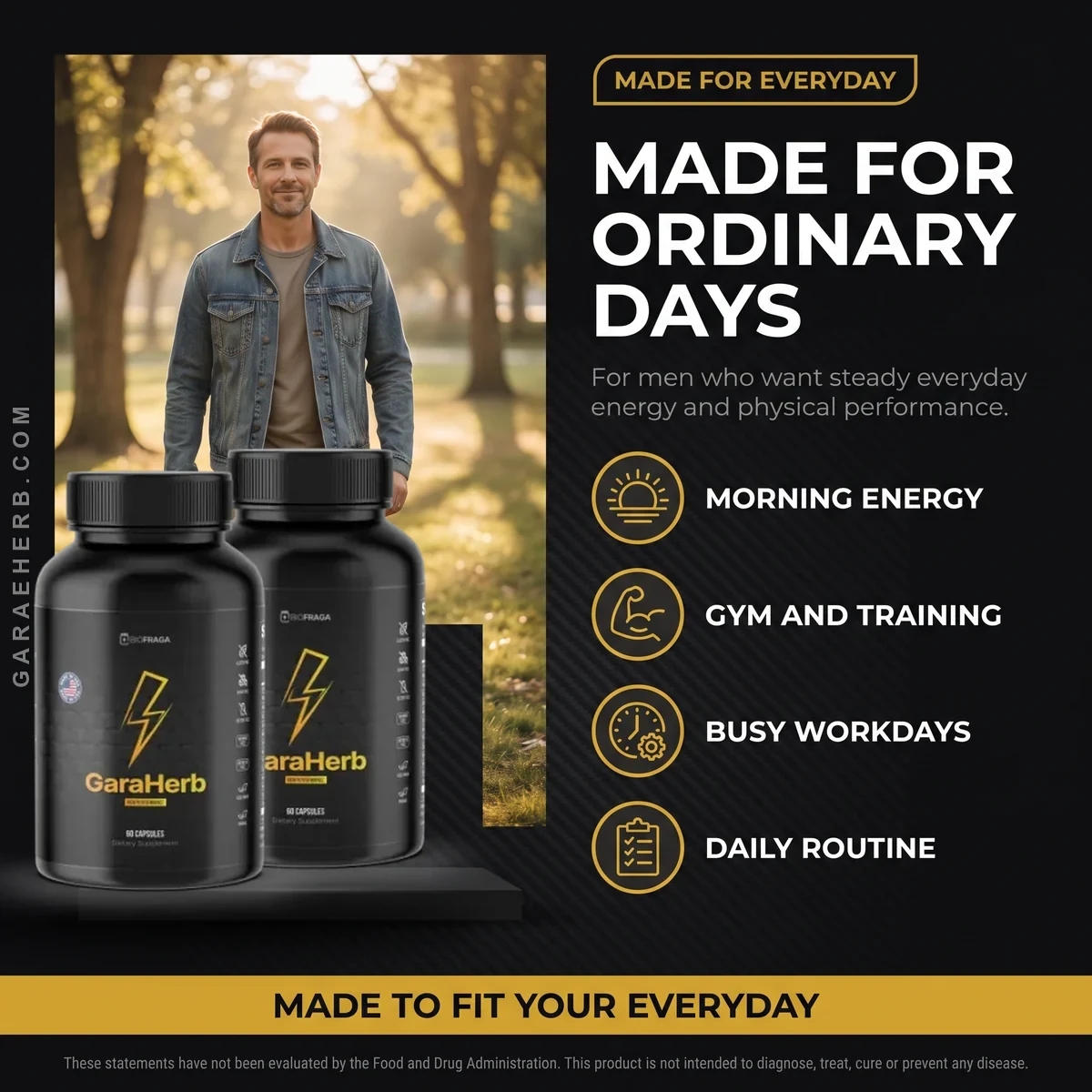
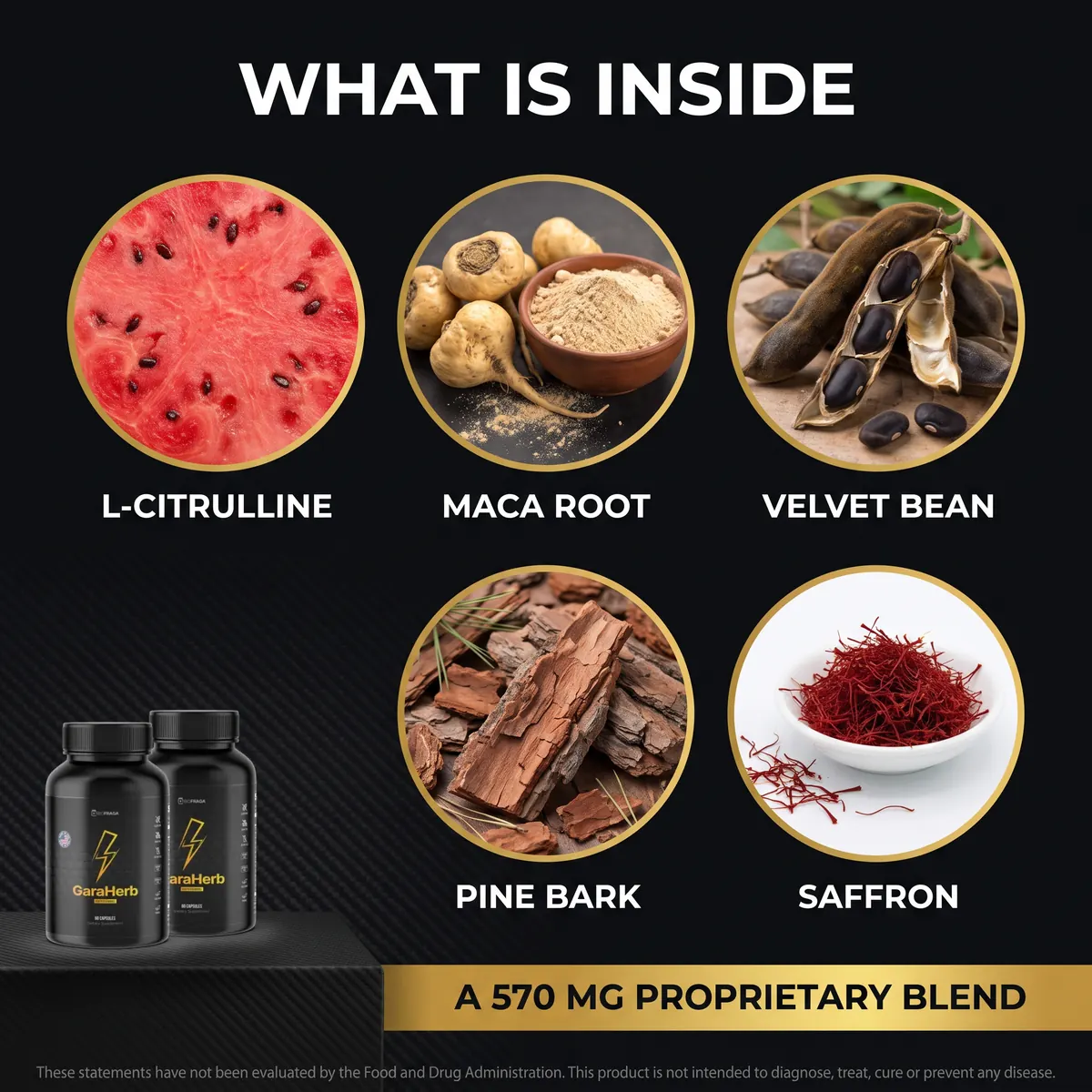
A note on our own product: Ashwagandha is not an ingredient in GaraHerb. This guide is general ingredient education. The GaraHerb Supplement Facts panel lists Vitamin B3, Zinc and a 570 mg blend of L-Citrulline, L-Carnitine, Pine bark, Velvet bean, Maca root, Grape skin and Saffron — you can read the full panel on the GaraHerb ingredients page.
Keep reading
- Maca root benefits for men: how the adaptogen works
- Zinc and testosterone: how the mineral supports men
- How to support male vitality naturally
- See the full GaraHerb formula and ingredient panel →
Frequently asked questions
What are the benefits of ashwagandha for men?
Ashwagandha (Withania somnifera) is an adaptogen used traditionally to support the body’s response to stress. In men it is valued for helping manage cortisol, supporting calm, sleep quality and everyday resilience, and for its indirect link to normal, healthy testosterone through better stress balance. It is general wellness support, not a treatment for any condition.
How does ashwagandha lower cortisol?
Ashwagandha is thought to act on the HPA axis, the stress-response system linking the brain and adrenal glands. As an adaptogen it helps the body respond to stress more calmly, which is associated with more balanced cortisol rather than forcing it artificially low. Better cortisol balance is one reason it is popular with busy, stressed men.
Does ashwagandha increase testosterone?
Ashwagandha is not a hormone and does not add testosterone from outside. The link is indirect: chronic stress and high cortisol can work against healthy testosterone, so by supporting a calmer stress response, ashwagandha helps create conditions in which the body’s own normal testosterone can be better maintained. It supports normal balance, not a supraphysiological boost.
What is a KSM-66 or withanolide standardized extract?
Withanolides are the main active compounds in ashwagandha root. A standardised extract states a fixed withanolide percentage, and named extracts like KSM-66 or Sensoril are branded, well-characterised versions. A stated withanolide percentage tells you the extract is measured for potency rather than being raw powder of unknown strength.
Is ashwagandha safe to take daily?
For healthy adults, standardised root extracts are generally well tolerated at labelled doses and are often taken daily for several weeks. Do not exceed the labelled amount. People with thyroid conditions, autoimmune conditions, or those taking sedatives or thyroid or other prescription medication should speak with a doctor first. It is not for those under 18, pregnant or breastfeeding.
References
- National Center for Complementary and Integrative Health. “Ashwagandha.” nccih.nih.gov
- Examine.com. “Ashwagandha: evidence-based analysis.” examine.com
- MedlinePlus, U.S. National Library of Medicine. “Ashwagandha.” medlineplus.gov
- National Institutes of Health, Office of Dietary Supplements. “Dietary Supplements: What You Need to Know.” ods.od.nih.gov
The GaraHerb Research Team is an independent group of men’s-health writers and supplement editors who turn ingredient science and label-reading know-how into plain English. We are not your doctor and we do not sell medical advice — our job is to help you understand how each active works so you can shop and supplement with confidence. Every guide is checked against primary sources such as the NIH Office of Dietary Supplements and peer-reviewed research, and reviewed for accuracy before publishing.
Spotted something that needs correcting? Reach us through our contact page, or read more about who we are.
† These statements have not been evaluated by the Food and Drug Administration. This product is not intended to diagnose, treat, cure or prevent any disease. This article is for general information only and is not medical advice. Speak with your physician before starting any new supplement.